
Founding of Sandy Mountain Festival Focused on Artisans, Meinig Park
By Abby Haney
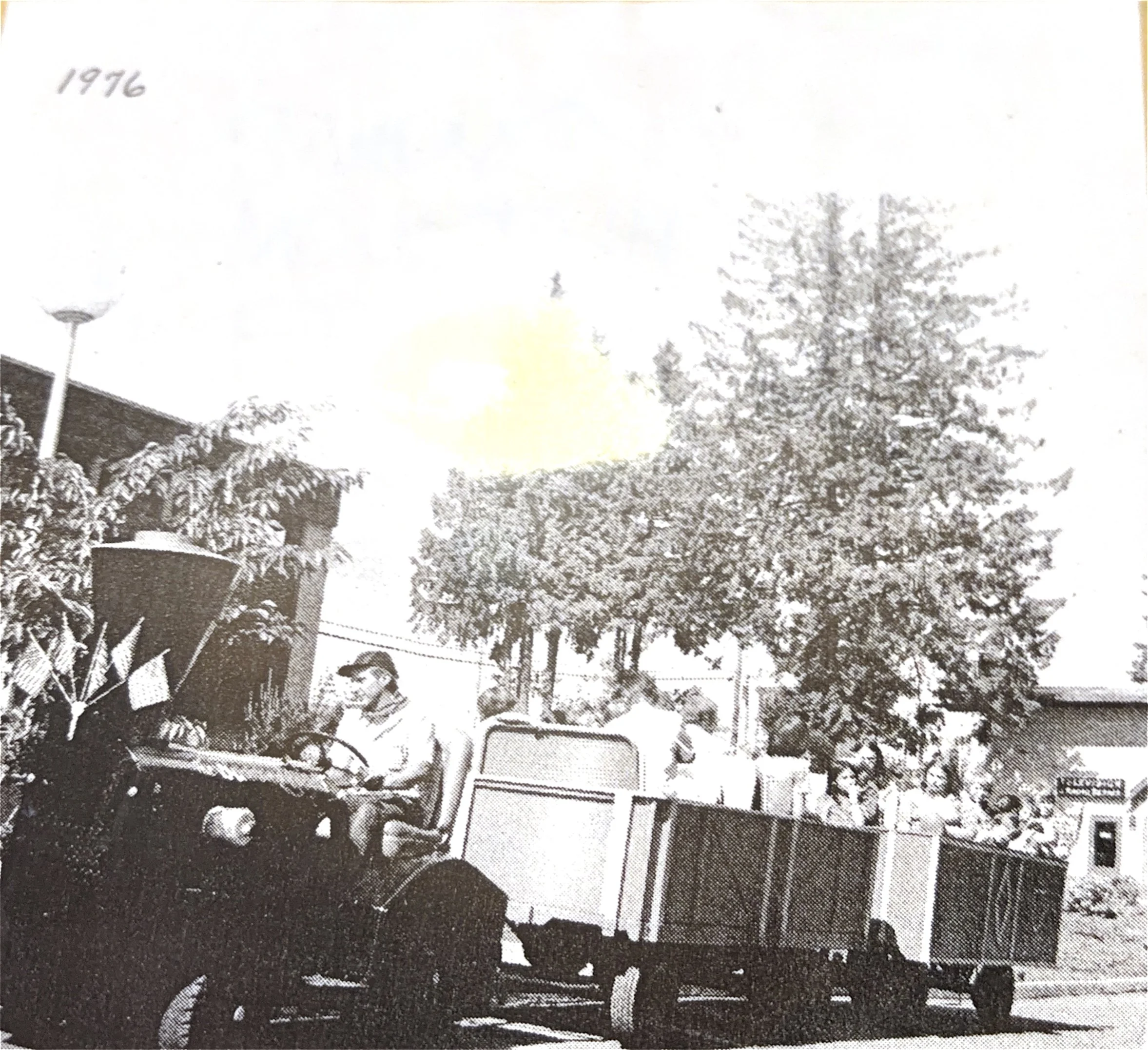
A train, called Sandy Trunk Line, was purchased and maintained by the city for events including the Sandy Mountain Festival. The company Sandy Trunk Line helped in moving the train to Sandy, causing the train to be named after them.
1974 marks the beginning of the Sandy Mountain Festival. Sandy Mountain Days didn’t begin until 1978. The festival began with the intention to highlight arts and crafts and Meinig Park. John Armstrong, a founder, was inspired by Shakespearean festivals and Eugene, Oregon’s Renaissance Fair.
“The original festival was arts and crafts in the park. It was totally focused on that location,” Armstrong said.
In the early years, numerous people influenced and started the festival including Armstrong, Florence Schmitz and Blushing Zebra (an arts and craft store) owners Lynn Ellis and Ann Fenwick. After the first year, many festival goers responded saying they heard about the festival through the Blushing Zebra.
“Any one helping in the early years of the festival is a founder,” Armstrong said.
The process to get there was tedious, starting with a city council meeting on May 6, 1974. The festival committee started through Sandy Chamber of Commerce and needed permission to use Meinig for the event by the city. While Armstrong didn’t attend the meeting, he assisted in the build up.
“I knew all the city council and the mayor. Before the meeting ever happened the skids were greased,” Armstrong said.
The committee listed two sets of focuses in their proposition: the purpose and problems.
Purpose:
Contribute to city progress
Offer residents and other opportunity to display/sell their work
Attract people to community
Draw attention to park
Work together
Have fun
Problems:
Park clean up
Specific park usage
Parking
Sanitation
Security
The motion was approved, while there was hesitation at first, with consideration of “sanitation facilities, parking and clean up work assured” as written in city council meeting minutes. Councilmen Youngbluth questioned use of the high school and Councilman Astelford questioned date change, both which were previously considered and deemed not suitable.
Armstrong along with the other founders searched for a Sandy Mountain Festival location. Armstrong discovered a park behind city hall and knew he found the festival site.
“I looked around Sandy for a potential festival. I looked out what is Tickle Creek and the woods and could hear, feel, and taste and smell all that was going on,” Armstrong said. “It [Meinig Park] was totally overgrown. There was the beginning of a bridge. It had not been used. When we decided that was the place and the city supported that. Bring your shovels, hose, rakes to carve out your display.”
Picking a date was a long process in which several factors influenced the decision of choosing the second weekend of July. The first was its relation to the Fourth of July; no events would occur during that weekend since it was after the holiday making it an opportunity to focus on the festival. The second was weather; Armstrong researched the weather throughout summer in Sandy and found the second weekend in July’s weather provided the best climate.
At the start, it was a one day event on that Saturday but by the second year, it was switched to Saturday and Sunday. Over time, the festival kept growing to include the parade on Thursday.
“It went from the Sandy Mountain Festival which was the arts and crafts festival in the park to Sandy Mountain Days,” Armstrong said.
When laying the foundation for the festival, a value that was instigated was no commercializing and profit off of fees. The festival was to promote artisans and having a low fee supported this value. Even more so, the emphasis was on no commercialization.
“We weren't gonna commercialize the event. The idea was not to commercialize because the park there were no gate. We didn't want to charge. We wanted it to be free flow,” Armstrong said.
Since the beginning, music has been a key aspect to the festival. During the day, various musicians played for a couple of hours, allowing them to not only share their sounds but give people an opportunity to hear various music types. At the start, a stage wasn’t available but that didn’t stop them. The committee borrowed risers from the high school which bands played on. Musicians Dale Nicholls and George Bruns (a Disney legend) were key in the music side of the festival.
“Music became a huge part because of Dale Nicholls. He was a musician. He was really supportive of this right off the bat,” Armstrong said. “[Nicholls and Bruns brought] together their friends who were accomplished musicians. They put together [two separate] big band[s] who played Sunday. People found out.” Nicholls' band was called “Big Band Sound” and Bruns was “Dixie Land.” Both of these artists drew large crowds during their performing times of 1 p.m. (Nicholls) and 3 p.m. (Bruns).
A common problem during the festival was parking and traffic, an issue many find today. In the early years, community members united to find a solution: a London Double Decker Bus. People could park farther and the bus would carry festival goers the rest of the way.
“The biggest problem in the first year was parking and traffic,” Armstrong said. “That was the only issue we had that year. The solution was that he [Gale Meier who owned a supermarket across from Joe’s Donuts] and Jim Patrick, who owned a trucking company [Sandy Truck Lines]. Jim and Gale got together and notified parking lifts. They [got] a London double decker bus to run. From parking lots to the park.”
Additionally, a train was available in Sandy during the festival to provide transportation. The train was maintained by Sandy Public Works Department.
“The city crew got excited about a train going to the park. The key was they had a sense of what the festival was about. They loved the idea, they loved the community,” Armstrong said.
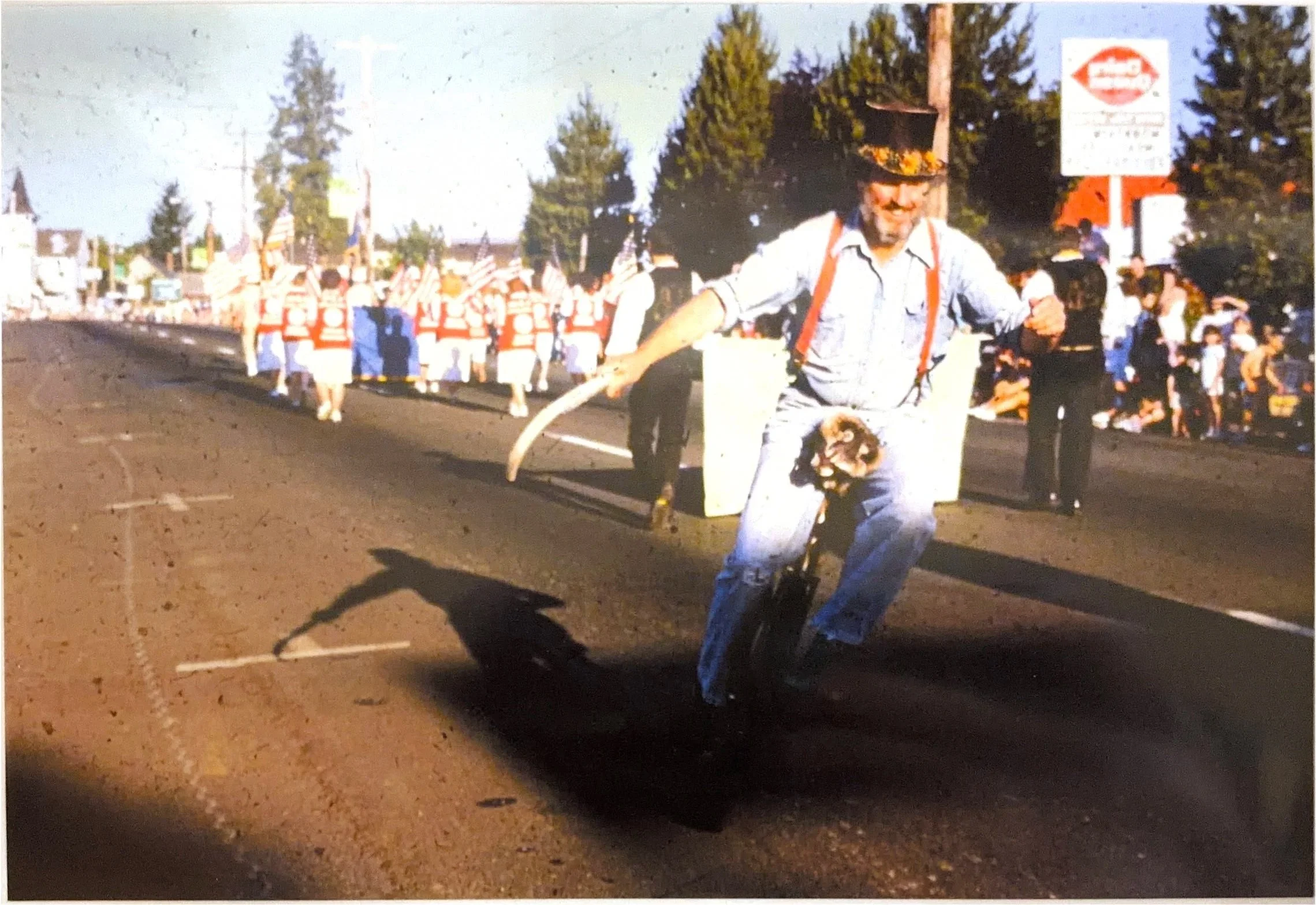
From the 1987 Sandy Mountain Festival parade, a participant rides a unicycle through the parade route. The parade, which occurs on the Thursday of festival week, wasn’t in the first Mountain Festival but added and expanded over time to become one of the many traditions.
Other key events in the early year timeline:
1974 First year of the festival for one day, Saturday July 13
1975 Festival moved to be two days, Saturday and Sunday
1976 Festival included a full lineup of music and a total of 115 artisans there. The parade had its first year on Saturday evening. The Birdcage theatre made its debut (SAT).
1977 At the festival, Dale Nicholls with All Star Band, and George Bruns with Dixieland Band preformed
1978 The festival expanded to be Sandy Mountain Days. Snowshoe softball (wore snowshoes while rounding bases) was a popular event; this was later changed to choker softball (tied ankles). Another popular event was the pet rock race. The festival royalty debuted. Darell Dempster joined the board for the festival.
1979 One of the many festival founders Lynn Ellis died a week before the festival. The International Bed Race Finals debut which was Ellis' idea. Additionally, the 10 K race debuted.
1980 There were in total 136 booths. The Sandy Recreation department took over all breed pet shows with a new rule of “all entries must have legs and be smaller than King Kong.” The pet rock race also had a new rule of “entries must wear muzzles.”
1981 George Bruns was the grand marshall for the Sandy Mountain Festival.
1982 The New Games Festival was introduced for the first year during Sandy Mountain Days.
1983 The Wine Fair and Feast tent by SACC began during the festival. Also the Sandy soap box derby debuted.
The festival committee wanted to enhance the festival by matching it to the public's needs. After the first festival, a survey was released in which goers respond about their experience in the festival. Common trends included:
Thought there were just right amount of vendor but believed in “too more the merrier”
Increase the festival length for two days
No registration fee as seen in other festivals, fees “really turned a lot of craft people off”
“Better parking facilities” “more signs on road leading to park area”
“Good festival, good turnout - 2 days might be better and more publicity”
“Best thing to happen to Sandy in many years” “Brought Sandyites out to get to know each other and their town”
No registration fee as it imposes on the artist. “If the exhibitors bring attention and money to your community as you expect, then you have been paid”
A different organization of the exhibits
The first year laid the foundation for the festival. However, the community and visitors made the festival what it is today by supporting its growth, providing feedback and adding new ideas each year to the festival. Armstrong especially believes anyone who supports the festival is a part of the committee in making it what we know as today.
Abby Haney was the Editor-In-Chief at Sandy High School for the Pioneer Press and is a writer at large for The Sandy Historical Society and The Sandy Standard.
